Table of Contents
If you’ve been searching for the real Shopify monthly cost, you’ve probably landed on the official pricing page and walked away with more questions than answers. The plan fee is just the starting point. What you actually pay every month depends on your revenue, your team size, the apps you run, and whether you use Shopify’s own payment processor or a third-party gateway.
This guide breaks down every plan, every fee, and the hidden costs most merchants don’t factor in — so you can build a realistic budget before you commit.
Table of Contents
What the Monthly Cost of Shopify Looks Like by Plan
There are four main plans for running a full Shopify store. Here’s a clear overview of the monthly fees at each tier, both on monthly and annual billing:
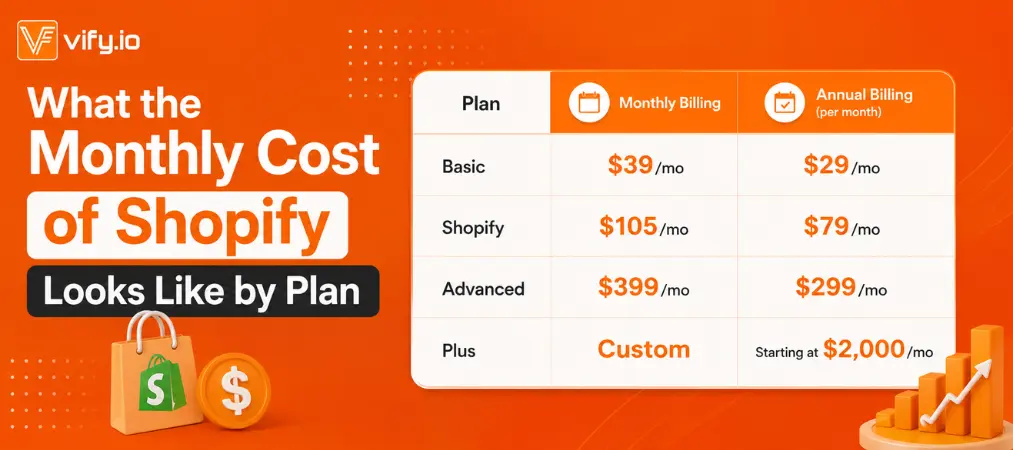
Opting for annual billing saves around 25% compared to paying month-to-month — a meaningful difference over 12 months, especially on the Advanced plan where you’d save $1,200 per year.
There’s also a Starter plan at $5/month, but it only gives you a shareable checkout link, not a full storefront. It’s designed for creators selling through social media, not merchants building a real ecommerce operation.
Breaking Down Shopify Monthly Fees by Plan
Basic — $39/month
The Basic plan is the entry point for a genuine online store. You get a full storefront, product management, 10 inventory locations, and 24/7 live chat support. The catch: there are no staff accounts, meaning only the store owner can access the backend. The moment you need a team member to log in, you’ll need to upgrade.
Credit card rates through Shopify Payments sit at 2.9% + $0.30 per online transaction. If you use a third-party payment provider like Stripe or PayPal instead, Shopify adds an extra 2% surcharge on every sale.
Who it’s for: Solo founders and early-stage stores doing under $50K/month.
Real cost example: A store doing $30,000/month in sales pays roughly $39 in subscription fees plus around $900 in payment processing — approximately $939/month total.

Grow — $105/month
The Grow plan adds five staff accounts, professional reports, multi-market selling, and better shipping discounts. Card rates drop to 2.7% + $0.30, and the third-party gateway surcharge falls to 1%.
This is the plan where most growing brands land. The moment you have a second person managing the store, Basic simply doesn’t work.
Who it’s for: Brands doing $50K–$200K/month with a small but growing team.
Real cost example: At $150,000/month in revenue, expect around $105 in subscription fees plus roughly $4,080 in processing — approximately $4,185/month.

Advanced — $399/month
Advanced unlocks 15 staff accounts, custom report builders, real-time carrier-calculated shipping rates, and automatic duties/import tax calculation. It also supports up to 3 international markets and 10 inventory locations. Card rates improve to 2.5% + $0.30, and the third-party surcharge drops to 0.6%.
If your store ships internationally or runs flash sales, this is the tier that starts to make financial sense.
Who it’s for: Brands doing $200K–$800K/month, especially with international operations.

Shopify Plus — from $2,300/month
Shopify Plus is built for enterprise-scale operations. The base fee starts at $2,300/month on a 3-year contract or $2,500 on a 1-year term. Above around $800K/month in revenue, pricing shifts to 0.35% of GMV, capped at $40,000/month.
For that, you get unlimited staff accounts, full checkout customization via Checkout Extensibility, native B2B wholesale channels, up to 10 expansion stores, Shopify Audiences for ad targeting, and 40x the standard checkout capacity. POS Pro is included for up to 20 locations — which alone can save $10,000+ per year for multi-location retailers.
Who it’s for: Brands doing $1M+ annually, multi-brand or multi-market operations, and anyone who needs B2B alongside DTC.

Monthly Cost for Shopify: What Gets Added on Top
The subscription fee is just the foundation. Most merchants significantly underestimate their monthly costs because these additional charges aren’t visible on the pricing page.
Transaction and Payment Processing Fees
Every sale on Shopify carries a processing fee. If you use Shopify Payments, that’s just the card rate. If you use a third-party gateway, Shopify adds its own surcharge on top of whatever your processor charges.
Here’s what Shopify takes from a $100 online sale:
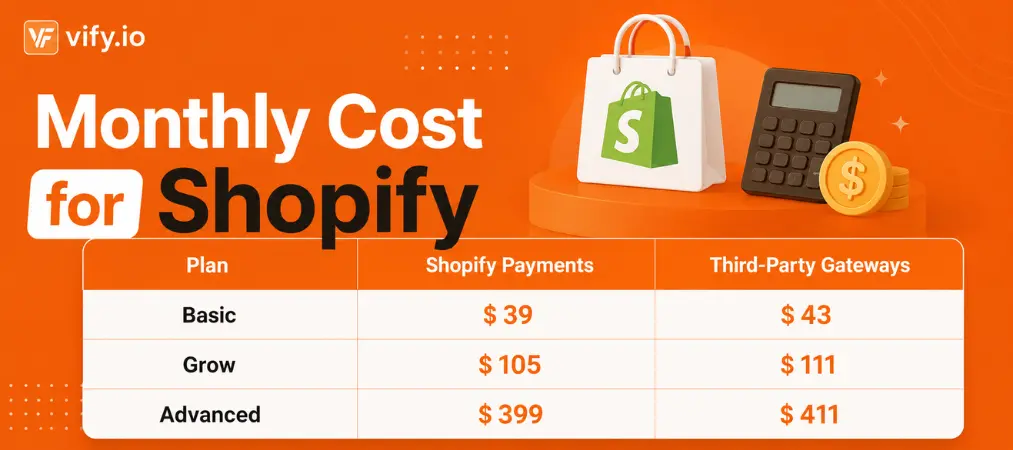
At scale, these differences matter enormously. A store doing $1M in annual GMV pays between $31,000 and $55,000 per year in payment processing fees depending on plan and gateway choice.
Third-Party Apps
Shopify’s platform covers the essentials, but most stores rely on apps for email marketing, reviews, upsells, analytics, loyalty programs, and more. Mid-market brands typically spend $350–$1,400/month on apps. Unlike hidden developer hours on self-hosted platforms, this cost is visible and predictable — but it needs to be in your budget from day one.
If you’re looking for ways to streamline operations without stacking paid apps, tools like Vify Order Printer PDF Invoice can handle professional invoicing and order documentation directly within your Shopify store at no extra complexity.
Shopify Email
The first 10,000 emails per month are free. Beyond that, additional sends cost $1 per 1,000 emails up to 300,000, then scale down to $0.65 per 1,000 after that. Stores with large subscriber lists often pair Shopify Email with a dedicated ESP, adding another recurring cost.
Shopify Tax
For US merchants, Shopify Tax is free on the first $100,000 of global sales per year. After that threshold, a 0.35% calculation fee applies per eligible order (0.25% for Plus merchants), capped at $0.99 per order and $5,000 per region annually.
Custom Domain
A custom domain runs around $10–$20/year from Shopify or an external registrar. Minor cost, but worth including in the full picture.
Shopify POS
If you sell in-person, the basic POS Lite is free. But POS Pro — which covers multi-location inventory, staff permissions, and buy-online-pick-up-in-store — costs $89/month per location ($79/month on annual billing). For a brand with three physical stores, that’s $267/month added to the base plan. On Plus, 20 POS Pro locations are included at no extra charge.
Managing invoices and order records across multiple locations becomes a lot simpler with the right setup — see how Shopify store owners handle order documentation efficiently without adding unnecessary overhead to their monthly tool stack.
What a Realistic Monthly Budget Looks Like
Once you add the subscription, processing fees, and apps together, here’s what a real monthly spend looks like for different store sizes:
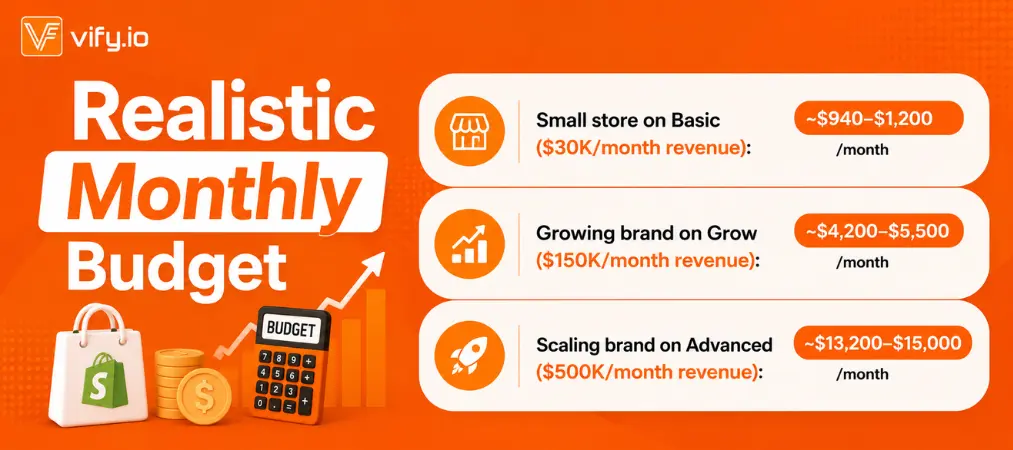
Small store on Basic ($30K/month revenue): ~$940–$1,200/month
Growing brand on Grow ($150K/month revenue): ~$4,200–$5,500/month
Scaling brand on Advanced ($500K/month revenue): ~$13,200–$15,000/month
These are realistic estimates that include subscription, payment processing, and a modest app stack. They don’t include themes, custom development, or POS costs.
When It Makes Sense to Upgrade Plans
The right time to move up a tier is when the savings on transaction fees outweigh the increase in subscription cost. On Basic, you pay 2.9% + $0.30 per card transaction. Moving to Grow saves 0.2% per transaction. At $150K/month in sales, that’s $300/month saved in fees alone — more than enough to justify the $66/month difference between Basic and Grow.
The same logic applies when moving to Advanced: the 0.2% drop from Grow to Advanced saves $500/month at $250K in monthly revenue, while the plan upgrade only costs $294/month more.
Quick Answers: Shopify Monthly Cost FAQs
How much does Shopify cost per month?
The subscription ranges from $29/month (Basic, annual billing) to $2,500/month (Plus). Total monthly spend — including payment processing and apps — is considerably higher for most active stores.
What are the Shopify monthly fees besides the subscription?
Card processing fees (2.15%–2.9% + $0.30 per transaction), third-party gateway surcharges (0.2%–2.0%), app subscriptions, POS Pro fees, email costs beyond 10,000 sends, and optional tax calculation fees.

Does Shopify charge transaction fees?
Only if you use a third-party payment gateway instead of Shopify Payments. With Shopify Payments, you pay only the card processing rate — no additional Shopify fee on top.
Is Shopify worth it for a small business?
For stores doing under $50K/month with simple needs, Basic at $39/month (or $29/month annually) is hard to beat. The total monthly cost for a $30K/month store comes to roughly $940, which is competitive against self-hosted alternatives once you factor in hosting, security, and maintenance.
Can I try Shopify for free?
Shopify offers a 3-day free trial, followed by 3 months at $1/month on the Basic, Grow, and Advanced plans — a practical way to test the platform before committing to full pricing.
Wrap Up
Understanding the true Shopify monthly cost goes far beyond what the pricing page shows. The subscription fee gets you through the door — but your real monthly spend is shaped by how much you sell, which payment processor you use, how many apps your store depends on, and whether you need physical retail tools like POS Pro.
For small stores on Basic, the total monthly cost for Shopify can stay under $1,000 a month and remain competitive against any alternative. For growing brands on Grow or Advanced, that number climbs alongside revenue — but the lower transaction fees at higher tiers often offset the subscription increase, making upgrades financially logical rather than just feature-driven.
The key takeaway: build your budget around the full picture, not just the plan price. Factor in processing fees, your app stack, and any POS or email costs before deciding which tier fits your business. When you do that, the monthly cost of Shopify becomes a lot more predictable — and easier to justify.