Shopify Basic Plan: Pricing, Features & What You Get
by jade jadePosted on
Table of Contents
Starting an online business means making dozens of decisions before your first sale — and one of the most consequential is choosing the right Shopify plan. Go too basic and you risk outgrowing it in months. Overspend on features you don’t need yet, and you’re burning cash before you’ve found product-market fit. The Shopify basic plan sits right in the middle of that equation: a full-featured online store at an accessible price point designed for merchants who are serious about selling.
So what does basic Shopify actually get you? This guide breaks down every feature, the real pricing across the US, UK, India, and Pakistan, and the limitations you should know before you click “subscribe.”
Table of Contents
What the Shopify Basic Plan Actually Is
Shopify currently offers five main pricing tiers: Starter, Basic, Grow, Advanced, and Shopify Plus. The basic plan sits at the beginning of the serious-seller range — a meaningful step up from the link-based Starter plan, without the operational overhead of higher tiers.
The clearest distinction between Starter and Basic is the storefront itself. With Starter, you can only sell via embedded buy buttons or social links. With the basic plan, you get a fully customizable online store, your own domain setup, a complete product catalog, and access to the entire Shopify admin dashboard. For any merchant who wants customers to browse and buy from a real store, Basic is the practical minimum.
Shopify Basic Plan Pricing Across Key Markets
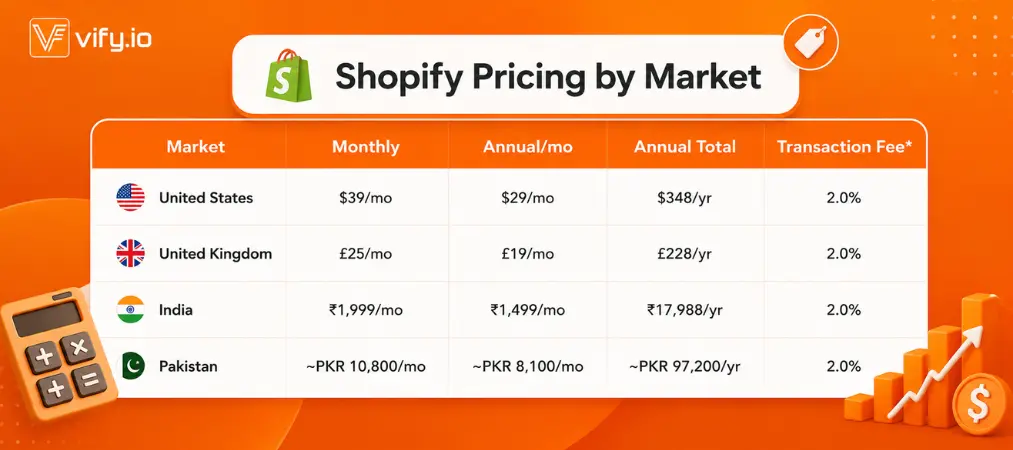
The Shopify basic plan costs $39 per month on a monthly billing cycle in the United States, or $29 per month when billed annually — a 25% saving. However, prices vary by country, so merchants outside the US should budget using local figures rather than USD estimates.
Transaction fee applies only when not using Shopify Payments. If Shopify Payments is available and activated, this fee is waived.
Shopify Basic Plan UK
In the UK, the monthly plan runs at £25 per month, with the annual option reducing this to £19 per month. Shopify Payments is available for UK merchants, which means the 2.0% third-party transaction fee can be avoided entirely by activating it as your default payment processor — making the basic plan even more cost-efficient for UK-based stores.
Shopify Basic Plan India
The Shopify basic plan price in India is approximately ₹1,999 per month on monthly billing, or around ₹1,499 per month on the annual plan. One important caveat for Indian merchants: Shopify Payments is not currently available in India, which means the 2.0% transaction fee will apply across all external payment gateways. Popular integrations like Razorpay, PayU, and CCAvenue work smoothly with the Basic plan, so checkout experiences remain solid — but the transaction cost is worth factoring into your margin calculations from day one.
Shopify Basic Plan Price in Pakistan
The Shopify basic plan price in Pakistan sits at approximately PKR 10,800 per month on monthly billing, or around PKR 8,100 per month on an annual plan (roughly PKR 97,200 per year). These figures are based on current USD-to-PKR exchange rates and may shift over time. As with India, Shopify Payments is not available in Pakistan, so the 2.0% third-party transaction fee applies. Pakistani merchants typically work around this using Stripe via a US-registered business entity, 2Checkout, or other compatible local payment solutions.
A Full Look at Basic Shopify Features
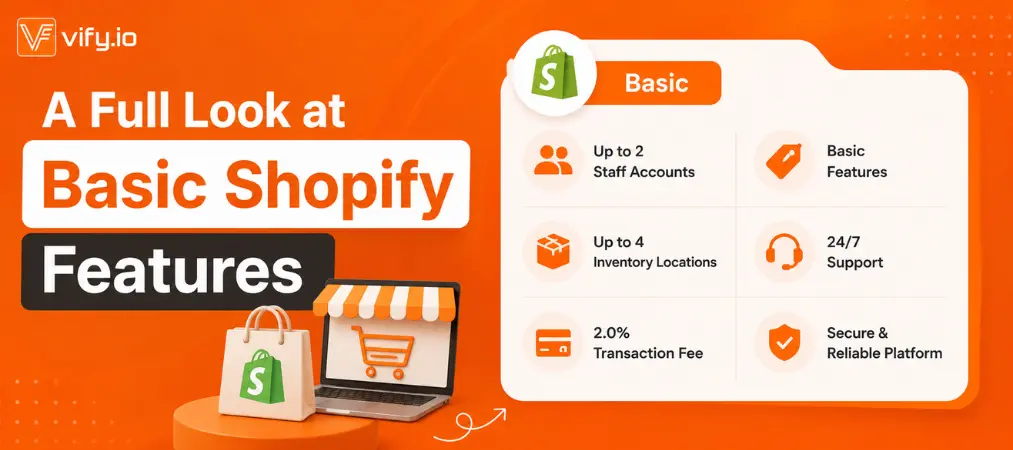
Despite being the entry-level paid plan, basic Shopify is genuinely well-equipped for early-stage stores. Here is a breakdown of what is included.
Online store and storefront. You get a fully customizable storefront powered by Shopify’s theme editor. Choose from free and premium themes, adjust layouts, colors, and typography without touching code, and list an unlimited number of products with variants, images, and detailed descriptions.
SSL security and blog engine. Every store on the Basic plan comes with a free SSL certificate (HTTPS), which protects customer data and is a baseline trust signal for shoppers. The plan also includes a built-in blogging engine, useful for content marketing and improving organic search visibility.
Sales channels. Merchants can sell across multiple channels simultaneously — the online store, Facebook Shop, TikTok Shop, and with third-party apps, Amazon and eBay as well. This multi-channel capability is a significant advantage over the Starter plan, which limits you to embedded links.
Payments and checkout. The Basic plan supports Shopify Payments where available, which eliminates transaction fees and offers a streamlined, branded checkout. It also connects with over 100 third-party payment gateways. The checkout itself includes one-page checkout, Shop Pay accelerated checkout, and 3D Secure authentication out of the box.
Discount tools and abandoned cart recovery. Merchants can create discount codes (percentage off, fixed amount, free shipping, buy-one-get-one), run automatic checkout discounts, sell gift cards, and trigger automated abandoned cart recovery emails. These are conversion tools that would cost significant money as third-party add-ons on other platforms.
Reporting. The Basic plan now includes access to all Shopify reports, including the ability to create custom reports using data explorations — a notable upgrade from older plan tiers. For most new merchants, this level of reporting is more than sufficient to track performance and identify growth opportunities.
Apps and integrations. You get unrestricted access to the Shopify App Store with over 18,000 apps. Whether you need an invoice and order printing solution, email marketing, dropshipping tools, or accounting integrations, the Basic plan places no limits on which apps you can install.
💡 Pro tip: Once your store is live, setting up a professional invoicing workflow early saves significant time as order volume grows. You can read more about building efficient order documentation processes on the Vify Order Printer blog, which covers everything from PDF invoice setup to automating packing slips on Shopify.
Limitations Worth Knowing Before You Commit
No plan is perfect. Here are the genuine constraints of the basic plan that could matter depending on your business model.
Staff accounts. The Basic plan does not support adding staff accounts. If you need team members to access the Shopify admin separately — for managing orders, inventory, or customer service — you will need to upgrade to the Grow plan or higher. For a solo founder or two-person operation this rarely matters, but it becomes a bottleneck quickly as teams grow.
No third-party carrier-calculated shipping. Activating real-time rates from third-party carriers like UPS, FedEx, or DHL requires the Grow plan or above. Basic plan merchants are limited to Shopify’s own calculated rates and manual flat-rate shipping rules.
Transaction fee at scale. The 2.0% third-party transaction fee is manageable at low volume, but scales up fast. At $50,000 per month in revenue, that is $1,000 per month in fees — already more than the Grow plan costs ($105/month). Merchants reaching this threshold should run the numbers and consider upgrading.
No duty and import tax calculation at checkout. Automated duties and import tax display at checkout — useful for stores with significant international customers — requires the Advanced or Plus plan.
The key nuance here: most of these limitations only become real friction at a certain operational and revenue scale. For a store under $10,000 per month with a small team, the Basic plan handles nearly everything without issue.
Is the Shopify Basic Plan the Right Starting Point?
For the majority of new ecommerce businesses, yes. The Shopify basic plan provides everything needed to launch a professional store, process payments, manage products, and sell across multiple channels — all without the higher monthly cost of the Grow or Advanced plans.
The calculus is straightforward: start on Basic, grow into it, and upgrade when the limitations (staff accounts, transaction fees, or carrier shipping) start costing you more than the upgrade would. Shopify makes plan changes seamless, so there is no risk in starting lean.
📄 Want to automate your invoicing from day one? Many merchants on the Shopify basic plan use the Vify Order Printer PDF Invoice app to generate professional invoices, packing slips, and receipts automatically. The Shopify invoice generator guide on the Vify blog walks through the best free and paid options available for Basic plan stores.
Final Thoughts
The Shopify basic plan remains one of the strongest entry-level ecommerce solutions available. Whether you are launching from the US, UK, India, Pakistan, or anywhere else, the plan gives you a real, customizable store with solid selling tools at a price that does not require external funding to justify. Start with Basic, build your operations smartly, and scale up when the numbers tell you to.
Ready to build your store? Explore our in-depth guides, tips, and e-commerce resources at https://orderprinter.vify.io/ to take your Shopify journey further.
Starting a Shopify online store is one of the most accessible ways to launch a business today — but accessible doesn’t mean easy. Thousands of stores open every week, and most struggle to gain traction not because of their products, but because of how (or how poorly) the store is set up, structured, and presented.
This guide cuts through the noise to give you what actually works: from the very first setup steps to the growth...
Every Shopify merchant faces the same math problem: acquiring new customers is expensive, but the customers already on your site are a goldmine waiting to be tapped. That’s where upsell apps on Shopify come in. By showing the right offer at the right moment — before checkout, inside the cart, or right after payment — you can increase your average order value (AOV) by 15–30% without spending an extra dollar on ads.
This g...
Your checkout page is the most critical moment in your customer’s journey. A shopper can browse your store, fall in love with a product, add it to their cart — and still leave without buying. In fact, the average eCommerce cart abandonment rate sits at around 70%, and a poorly designed checkout is one of the top culprits.
That’s why learning how to customize the Shopify checkout page isn’t just a design task — ...
If you’ve ever looked at your Shopify payout and felt something was missing, you’re not imagining it. Understanding how much does Shopify take per sale is one of the most important things a merchant can get right — and most people never look past their plan’s price tag.
Ever wonder how much does Shopify take per sale? It depends on your subscription plan, your payment method, and even where your customers are loc...
Whether you’re launching your first online business or juggling multiple stores at once, knowing how to handle your Shopify store login correctly makes a real difference in your day-to-day operations. A missed step during login — a forgotten password, an expired staff invite, or a skipped two-factor prompt — can interrupt your workflow at the worst possible time and cost you more than just a few minutes.
The reality is tha...
Choosing the right Shopify template is one of the most impactful decisions you will make for your online store. The good news? You do not need to spend hundreds of dollars. Today’s best free Shopify templates are built by Shopify itself, optimized for speed, mobile responsiveness, and conversion — and they are completely free to use.
This guide walks you through everything you need to know about best free Shopify templates: ...
The Shopify Starter Plan is the most affordable entry point on the Shopify platform, designed for creators, influencers, and small-scale sellers who want to sell online without building a full ecommerce website. For just $5 per month (globally), this plan replaces the old Shopify Lite and lets you share product links across social media, messaging apps, and existing websites — all powered by Shopify’s trusted checkout infrastru...
If you’ve started comparing ecommerce platforms, you’ve probably noticed that Shopify’s pricing page looks simple on the surface but gets complicated fast once you factor in transaction fees, add-ons, and annual discounts. Understanding Shopify monthly pricing before you sign up can save you from picking a plan that’s either too limited for your sales volume or more expensive than your store actually needs.
T...