Table of Contents
Returns aren’t going away — for most Shopify stores they sit somewhere between 15% and 25% of orders, and how you handle them decides whether a customer buys again or walks. Doing it manually through email threads and spreadsheets eats hours every week and rarely feels good on either side of the transaction.
That’s the gap the best Shopify returns apps close. They give shoppers a self-service portal, automate labels and inventory updates, and — done right — turn a chunk of refund requests into exchanges instead. This guide breaks down the top options, what each one does well, where it falls short, and how to pick without overpaying.
Table of Contents
What Does a Shopify Returns App Actually Do?
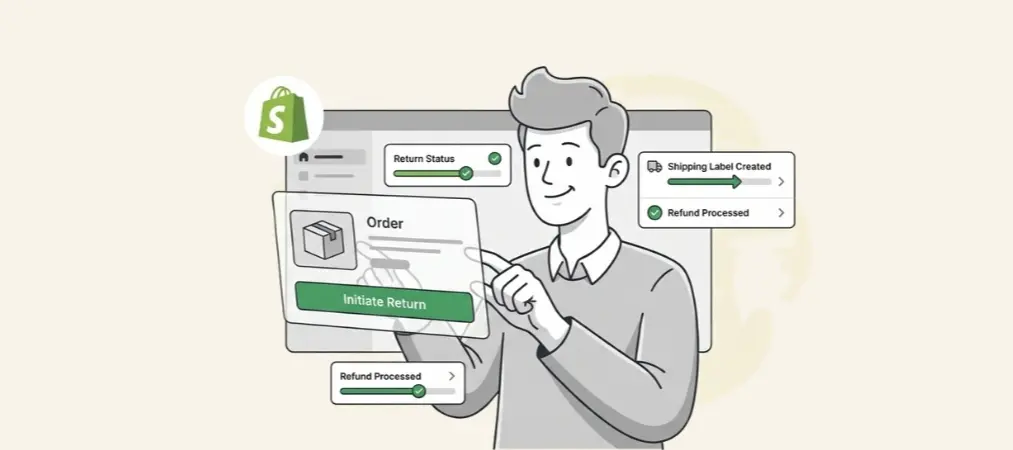
A returns app Shopify merchants install works as a layer between your storefront and your backend operations. Instead of a customer emailing support and waiting for a manual reply, they log a request through a branded portal, and the app handles the mechanics: generating a return label, applying your rules (return window, non-returnable items, restocking fees), updating inventory once the item is scanned back in, and notifying the customer at each step.
The stronger platforms go further — surfacing store credit or exchange options before a refund, flagging fraud or abuse patterns, and reporting on why items come back so you can fix the underlying product or listing issue.
Return-Only, Exchange-Focused, or All-in-One: Know the Difference
Not every app in this category does the same job:
- Return-only apps cover the basics: a portal, label generation, refund processing. Fine for low-volume stores that just need the manual work off their plate.
- Exchange-focused apps add store credit, bonus incentives, and product-swap flows designed to keep revenue in the store instead of refunding it.
- All-in-one platforms bundle returns with shipping, tracking, and customer support so the whole post-purchase journey lives in one dashboard.
If your store runs on dropshipping suppliers, return logistics get more complicated — items often can’t come back to a central warehouse the way they would with owned inventory, so the app’s rules engine and supplier-routing matter more than usual.
Signs You’ve Outgrown Shopify’s Native Returns
Shopify’s built-in return flow is fine at low volume, but watch for these signals:
- Restocking is a mess and staff can’t tell what’s actually sellable again
- Support tickets pile up because the process feels slow or confusing to customers
- Your team spends hours a week generating labels and answering “where’s my refund” emails
- You have no visibility into why items are coming back
Any one of these is a reasonable trigger to install a dedicated app.
What the Best Shopify Returns Apps Offer
| App | Specialization | Shopify Rating | Starting Price | Free Plan |
|---|---|---|---|---|
| Yanet Returns & Exchanges | Basic returns | 4.9/5 | Free | Yes |
| AfterShip Returns & Exchanges | All-in-one tracking + returns | 4.7/5 | $19/mo | Yes |
| Return Prime:Return & Exchange | Exchange-focused | 4.8/5 | $19.99/mo | Yes |
| Loop Returns & Exchanges | Exchange-first, high volume | 4.7/5 | $155/mo | Yes (basic) |
| ReturnGO Returns & Exchanges | Exchange-first, verification rules | 4.9/5 | $147/mo | Yes |
| Rich Returns & Exchanges | Returns, polished portal | 4.6/5 | $19/mo | No (30-day trial) |
| ParcelWILL Returns & Exchanges | Returns + tracking | 4.9/5 | Custom | Yes |
| EcoReturns | AI-powered return reduction | 4.9/5 | Custom | Yes |
The Best Returns App for Shopify: 8 Options Compared
Yanet Returns & Exchanges
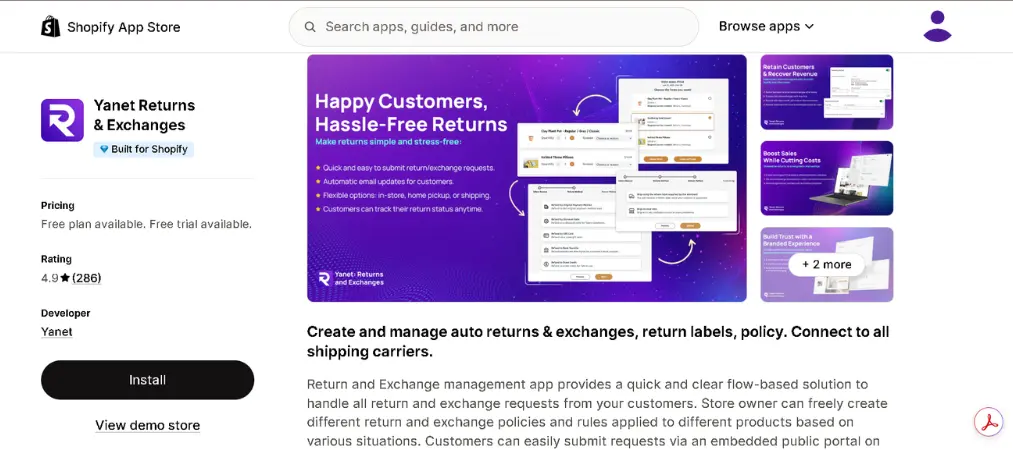
Yanet keeps it simple — a lightweight, free portal built for early-stage stores that just need the basics covered.
Pros: Completely free; quick setup; covers self-service requests and status notifications.
Cons: Requires a separate shipping integrator; limited customization and no advanced automation, so stores will likely outgrow it as volume climbs.
Key features: Self-service portal, automated status notifications, basic branding.
Shopify rating: Budget-tier, solidly reviewed
Pricing: Free plan available · Professional $9.99/mo (80 requests) · Ultimate $ 29.99/mo (Unlimited requests)
AfterShip Returns & Exchanges
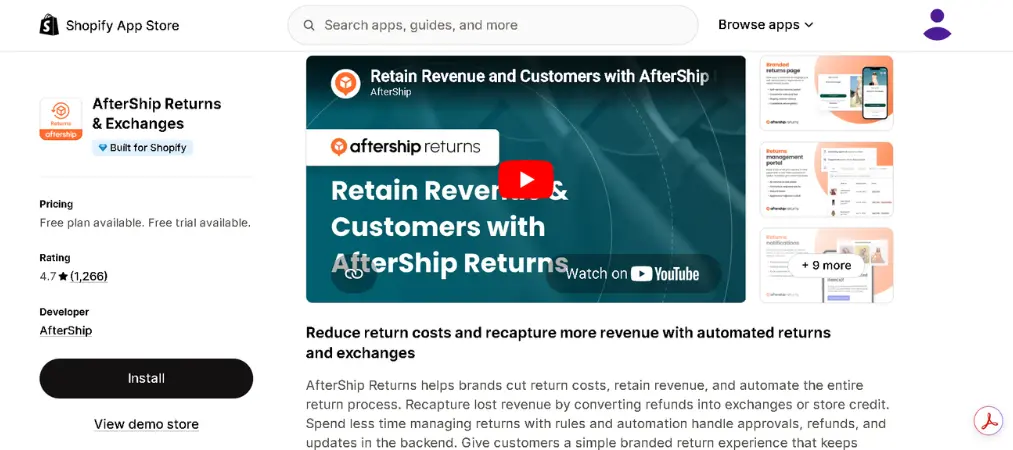
AfterShip extends its well-known tracking suite into post-purchase, letting you manage refunds, exchanges, and store credit from the same dashboard you may already use for shipment tracking.
Pros: Free tier for very low volume; taps into AfterShip’s 1,100+ carrier network; shared dashboard if you already run AfterShip tracking; solid return-reason analytics.
Cons: The entry plan is stripped down — custom domains, routing rules, and help-desk integrations often require an upgrade, and some long-time users report features quietly moving behind paywalls.
Key features: Branded self-service portal, smart return rules, auto-refund/auto-restock automation, carrier and warehouse routing.
Shopify rating: 4.7/5 (1,200+ reviews)
Pricing: Free (All Premium features) · Essentials $19/mo (20 returns) · Premium $119/mo (100 returns)
Return Prime: Return & Exchange
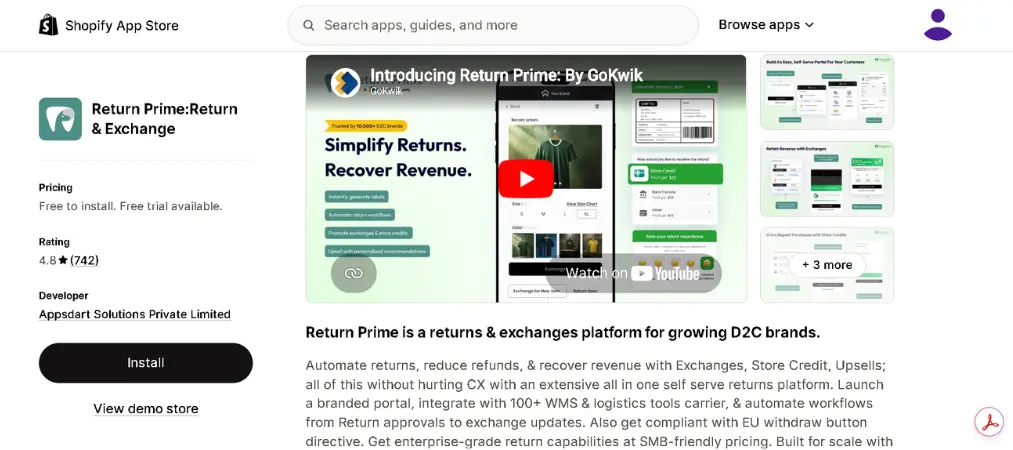
Built specifically for Shopify, Return Prime pushes customers toward exchanges and store credit with upsell prompts built directly into the return flow.
Pros: Generous free plan; fast setup, often live in under 15 minutes; 100+ integrations (Klaviyo, Gorgias, etc.); merchants report exchange rates climbing meaningfully after switching.
Cons: A few reviewers report the app injecting its own shipping rule that’s hard to remove; reporting is less granular than Loop or ReturnGO.
Key features: Customizable portal, automated labels and refunds, store-credit incentives, in-flow upsell recommendations, multilingual support.
Shopify rating: 4.8/5 (700+ reviews)
Pricing: Free (5 returns/mo) · Grow $19.99/mo · Thrive AI $79.99/mo · Scale $149.99/mo
Loop Returns & Exchanges
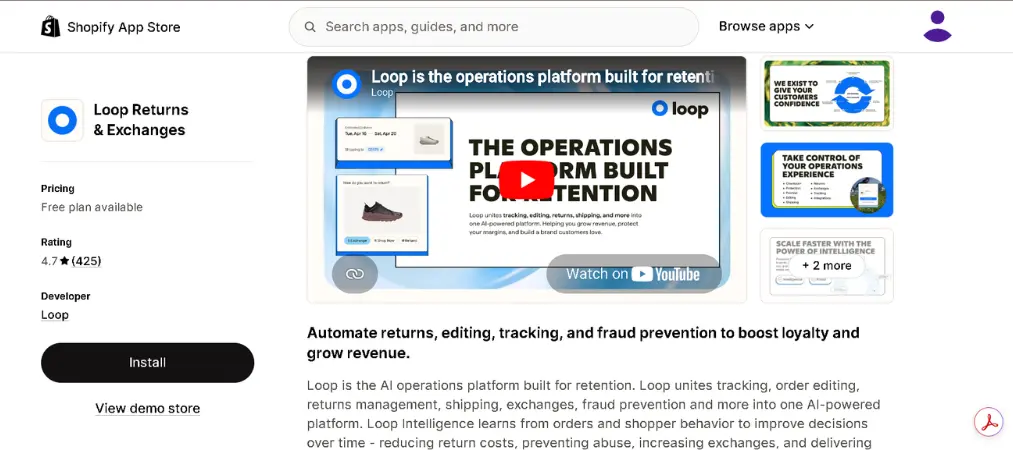
Loop is the exchange-first platform behind brands like Reebok and Princess Polly, built around a “Shop Now” flow that lets customers browse your whole catalog instead of swapping for the same item.
Pros: Best-in-class exchange-conversion tooling; handles very high volume reliably; strong reputation with larger DTC brands.
Cons: Expensive at $155–$340/month; needs a separate shipping integrator such as Easyship for labels; some merchants flag rigid contracts and auto-renewal friction.
Key features: Shop Now browse-to-exchange, bonus store-credit incentives, smart return rules, detailed analytics.
Shopify rating: 4.7/5 (400+ reviews)
Pricing: Free (basic, US/Canada labels) · Essential $155/mo · Advanced $340/mo
ReturnGO Returns & Exchanges
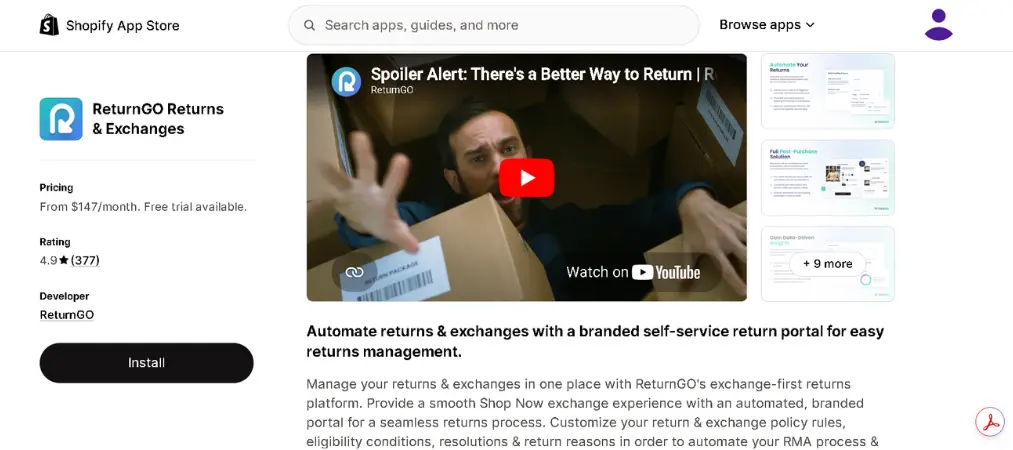
ReturnGO positions itself as an exchange-first platform trusted by brands like Decathlon and Under Armour, leaning heavily on rule-based automation and return verification.
Pros: Near-perfect rating; flexible rules engine (fraud checks, condition-based routing); handles international/EU return flows well.
Cons: Most plans still need a shipping integrator for label generation, effectively a second subscription; full automation sits behind pricier tiers.
Key features: Return verification rules, store-credit discount incentives, branded portal, detailed reporting.
Shopify rating: 4.9/5 (370+ reviews)
Pricing: Premium $147/mo · Pro $297/mo
Rich Returns & Exchanges
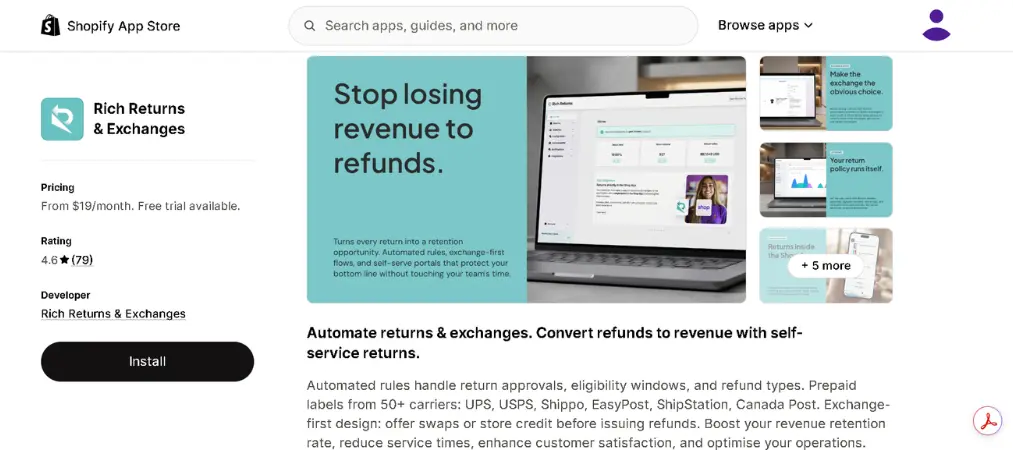
Rich Returns focuses on making the customer-facing experience feel premium, including a direct tie-in with Shopify’s native Shop app.
Pros: Polished, highly customizable portal; multilingual notifications; label printing without a separate integrator; long 30-day trial.
Cons: Lighter on revenue-recovery automation than Return Prime or Loop — better for stores that want a clean process over aggressive upsells.
Key features: Label generation, RMA confirmation rules, Shop App sync, automated notifications.
Shopify rating: 4.6/5
Pricing: Standard $19/mo (10 returns) · Pro $39/mo (50 returns) · Premium $99/mo (100 returns) · Enterprise Plus $199/mo (500+ returns)
ParcelWILL Returns & Exchanges
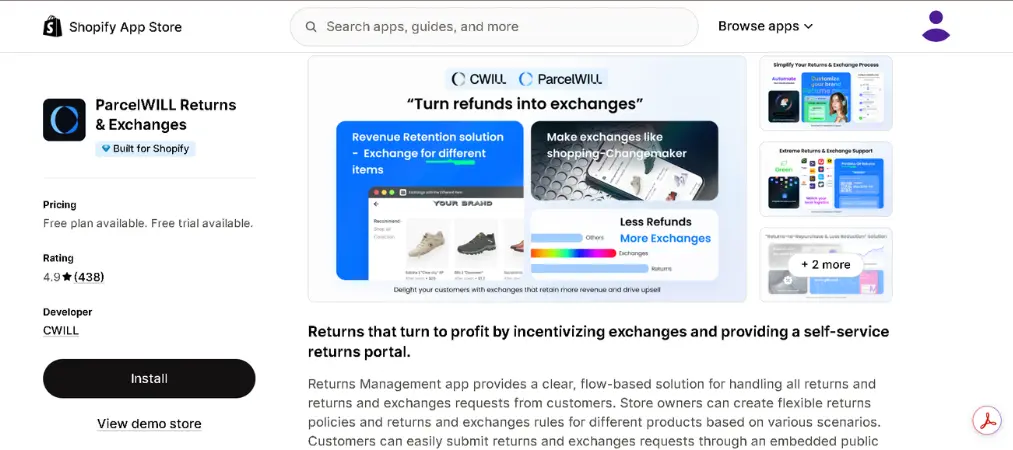
ParcelWILL is ParcelPanel’s dedicated returns product, Built for Shopify certified, designed to pair with ParcelPanel’s tracking app for one unified post-purchase stack.
Pros: Built for Shopify badge; strong rating; free plan available; no separate shipping integrator needed.
Cons: Exchange-optimization tools are shallower than Loop or ReturnGO — better suited to stores wanting reliable basics rather than deep upsell logic.
Key features: Self-service portal, free-return cost offsetting, carrier label generation, syncs with ParcelPanel tracking data.
Shopify rating: 4.9/5 (440+ reviews)
Pricing: Free plan available · Essential $29/mo (50 returns) ·
EcoReturns
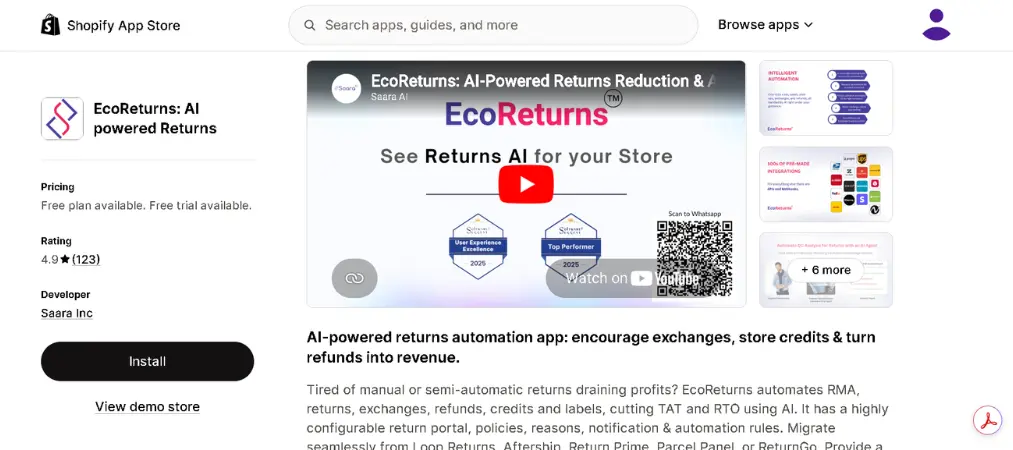
EcoReturns takes an AI-first approach, using automation agents to cut unnecessary returns before they happen and process the rest with minimal manual input.
Pros: Free plan; AI-driven insights that flag product or listing issues driving returns; full returns/exchange/refund/label workflow in one app.
Cons: Smaller review base than the more established names, so long-term reliability data is thinner.
Key features: AI approval agents, return-reduction analytics, store credit and exchange options, label generation.
Shopify rating: 4.9/5 (100+ reviews)
Pricing: Free plan available · Smart Automation $29/mo (100 returns) · Scale AI $99/mo (400 returns) · Enterprise $299/mo (Custom limits and pricing available)
Two Things to Check Before You Commit
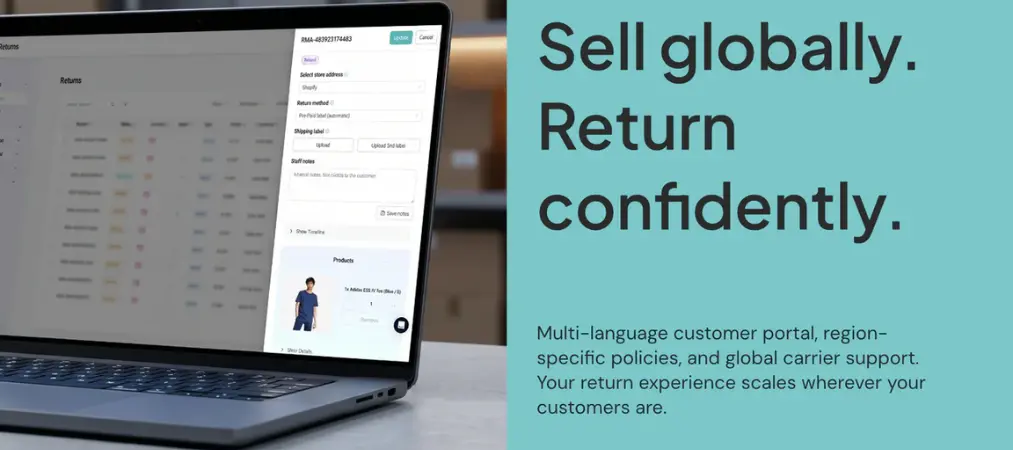
Hidden integration costs. Apps that need a third-party shipping connector effectively become two subscriptions. If you’re comparing sticker prices, add the connector cost before deciding which is actually cheaper.
Scalability. An app that’s fine at 20 returns a month can become a bottleneck at 200. Migrating later means re-training your team and re-mapping your policies, so it’s worth checking a plan’s ceiling now — the same way it’s worth understanding your full Shopify subscription cost before you commit to a store plan.
Setting Up Your Return Portal, Step by Step
- Install from the Shopify App Store and accept only the permissions the app genuinely needs (orders, inventory, customer data).
- Sync your store data — confirm orders, customers, and inventory are pulling through correctly, and force a manual sync if anything looks off.
- Configure your portal and policy — set return windows, non-returnable categories, exchange and store-credit options, then link the portal visibly from your footer or homepage.
- Turn on notifications so customers get automatic updates at each stage of the return.
FAQ: Shopify Returns Apps
What is the best returns app for Shopify?
There’s no single winner — it depends on your volume and goals. Return Prime and ReturnGO are strong all-around picks for stores wanting exchange conversion without enterprise pricing, while Loop suits high-volume fashion brands and Yanet or ParcelWILL work well for stores just starting out.

Is there a free returns app for Shopify?
Yes. Yanet is free with no paid tiers, and AfterShip, Return Prime, ReturnGO, ParcelWILL, and EcoReturns all offer free plans for low return volumes before you need to upgrade.
Do Shopify returns apps handle exchanges, not just refunds?
Most of the apps covered here do. Loop, Return Prime, and ReturnGO are built specifically to nudge refund requests toward exchanges or store credit, which helps retain revenue that a plain refund would lose.
Do I need a separate shipping app for return labels?
It depends on the app. AfterShip, Return Prime, Rich Returns, and ParcelWILL generate labels natively. Loop and some ReturnGO plans require a third-party shipping integrator, which effectively adds a second subscription — worth factoring into your cost comparison.
Can a returns app reduce my return rate, not just process returns?
Yes — apps like EcoReturns and Return Prime include analytics that flag which products or listings drive the most returns, so you can fix sizing charts, descriptions, or product quality issues at the source instead of only automating the fallout.
Conclusion
There are no best Shopify returns apps — it depends on volume, budget, and whether exchange conversion or simplicity matters more to you. Small or early-stage stores do fine on Yanet or a free tier from Return Prime or ParcelWILL; growing brands chasing exchange revenue should look hardest at Loop, ReturnGO, or Return Prime; stores already anchored in AfterShip’s ecosystem gain the most from staying there.
Whichever app you choose, pair it with clean, professional order documentation on the way out the door — Vify Order Printer generates branded PDF invoices and receipts automatically, so refunds and exchanges stay just as organized as the original sale.